
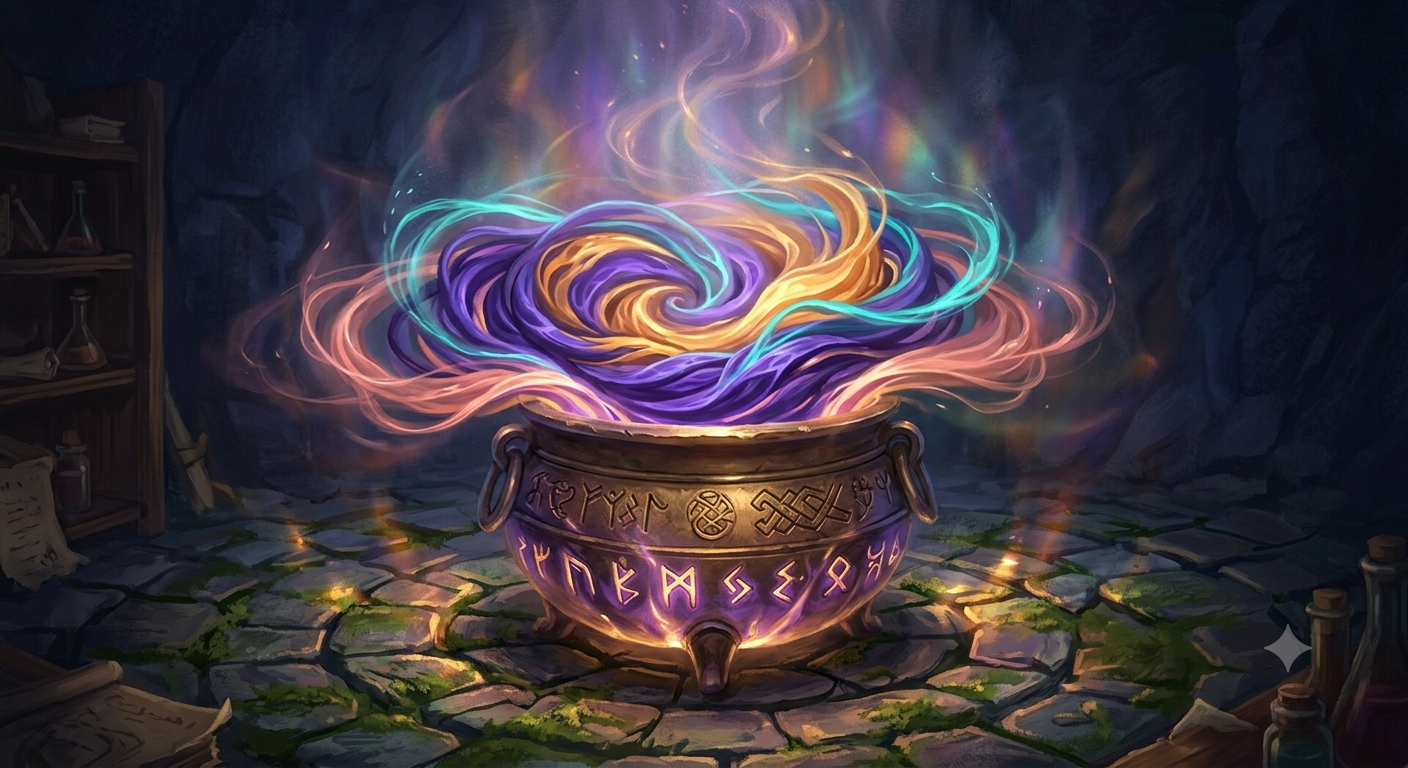
We all have been given our own special cauldrons. Some deep black in colour. Some with plastic stickers or green leaves and flowers, or as blue as the ocean. All different, yet the same.
We are all given our cauldrons to create ourselves as soon as we are born — who we are, what makes us us. The psychology of identity offers different perspectives on what, if anything, the cauldron contains at the start.
If we follow the psychodynamic and behaviourist view, we enter this world with a clean slate — our personality shaped entirely by learning and experience. But if we lean toward the genetic perspective, the cauldron already holds a bit of potion: traits inherited from our parents, their parents, and those who came before them.
The foundation of a person’s personality is formed in the first five years of life. After that, it becomes difficult to change.
Mixing the First Potion: The Stages of Personality Growth
At the age of a baby, we are already playing around, making The Potion. The early stages of personality growth are less about conscious choice and more about raw ingredients — whatever the environment and temperament provide.
A baby’s cauldron might look something like this:
- 1 cup of innocence
- ½ cup of arrogance
- 3 cups of love
- 5 cups of intense sensitivity
By the age of five, you can already begin to see what a child emphasises most — whether it is innocence, arrogance, or that deep well of sensitivity.
The Toddler’s Adjustments: Personality Development in Action
Just before the age of five, something shifts. The child becomes aware of their surroundings — of what they can achieve and what they cannot. And so, the cauldron is adjusted.
This is personality development happening in real time: the child distils out some of that intense sensitivity, reducing it from five cups to two and a half. In its place, new ingredients are folded in:
- 1 cup of bravery
- 2 cups of feistiness
- ½ cup of kindness
- ½ cup of respect
- 3–4 tablespoons of strong resolve
- 2 tablespoons of intellect
- 2–3 tablespoons of arrogance
- 3 cups of love
- 2 cups of passion
And, as is perhaps expected — 3 cups of adrenaline.
The Toddler Years: When the Potion Hasn’t Settled Yet
When one is a toddler, the components of the potion are not mixed well, so each of them springs out to express itself separately. On the exterior, we recognise this as sudden shifts of mood.
A toddler who is hyperactive and jolly one moment will suddenly start crying the next when he doesn’t get what he wants. The adrenaline component is subdued, and the emotional component surges forward to express itself — raw and unfiltered.
The Teenage Formula: More Ingredients, Higher Heat
As the toddler reaches the golden teenage years, the recipe undergoes significant revision. These are some of the key additions to the mix in this stage of personality growth:
- 2 cups of bravery
- 2 cups (or ¼ cup) of respect and kindness
- 4 cups of strong resolve
- 5 cups of intellect
- 6 cups of passion
- 6 cups of love
- 3 cups of arrogance
- 5 tablespoons of jealousy
- 3 tablespoons of tolerance
- And a dash of desired colour.
The concentration of intense sensitivity is reduced to 1.5 cups — which still encompasses anxiety, and potentially depression. Less in measure, but no less fierce in expression.
Crucially, all these components are now heated at a medium to high heat, so they interact with one another. Each component controls and monitors the others. This is what makes the psychology of identity so layered at this stage — a person begins to determine which components to express, when, where, and which to lean into most.
You can actually determine a person’s character by their behaviour — because character is simply the art of choosing which parts of yourself to show, and when.
The Cauldron Is Never Full
These components are quite a lot — and they are deeply defining of who a person is. But here’s a question worth sitting with: how full do you think the cauldron actually is at this point?
Not even half full. Much less than that.
Because every step you take, and every step life takes towards you, you learn a thing or two. The adjustments are continuous and ever-changing. The stages of personality growth don’t end at adolescence — they don’t end at all.
Even lying on your deathbed, the cauldron could be ¾ full at most — because no one can experience every aspect of life.
Books can help, of course 😏. And in some rare cases, something entirely new may be added to the mix — but only if the foundation of your potion accepts it. Only if the novel component doesn’t contaminate its consistency.
But in the end, we are all witches and wizards, continuously working at our cauldrons — refining, adjusting, and making it better than it was a moment ago, or better than the potions simmering in others’ cauldrons. The psychology of identity is not a destination. It is a practice, a craft, a lifelong process of personality development that never truly reaches its final form.
The stages of personality growth are not a ladder to climb and leave behind — they are layers you carry with you, each one adding depth to who you are becoming.
So tell me, the witch or wizard reading this — what potion are you conjuring? — This was originally posted here.


Leave a Reply