
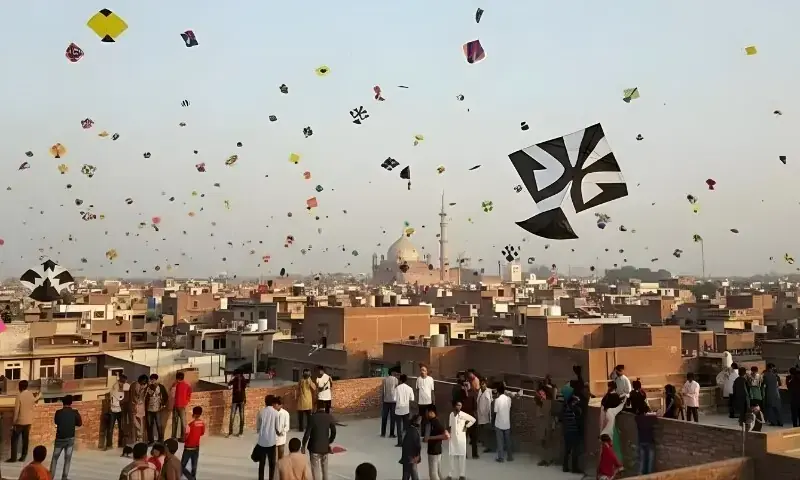
If you grew up in Lahore (or even just visited during the season), you already know the feeling: excitement in the day, the sudden yellow everywhere, and the instinct to look up … because the sky might be full of kites. Basant isn’t just an event. It’s a mood. It’s rooftop laughter, dhol beats, pakoray and jalebi on the table, and the whole city acting like it has one shared heartbeat.
Basant is not just a “kite-flying” event. It’s a cultural release valve. Lahore has always been a city that celebrates loudly, be it weddings, eid, cricket wins, you name it. Basant belong in the same category: shared space, joy and community energy.
But, as we romanticize the colours and the nostalgia, we quietly skip over what it has cost us in injuries, deaths, and fear.
When I started writing this blog post, I didn’t want to rely on vague “people say” statements. So I researched a bit for actual numbers … news, and any official figures i could find.That’s when i came across a set of statistics submitted by Punjab Police to the Lahore High Court about kite flying. These numbers don’t tell the entire story of Basant, but they do ground the debate in reality.
Let’s be honest. For many, Basant is an identity, It feels like heritage. But, apart from that, it creates a huge effect on local commerce. Kite makers, paper sellers, spool and spring shops, street vendors, rooftop caterers, sound system rentals, there are so many entire micro-economies that wake up around Basant.When Basant disappears, its not only fun that disappears. Work and earnings disappear too.
Since 2023, more than 90000 kites and over 5000 chemical strings were seized in enforcement operations and 5270 people arrested in cases related to kit flying according to the report submitted to Lahore High Court by Punjab Police.
These numbers alone tell you this is not some tiny hobby, it’s an industry.
Now The Hard Part which forces us to stop speaking in poetry and start speaking in consequences.
Basant becomes dangerous when kite flying competition turns into an arms race: chemical coated strings, metallic string, glass coated maanjha. When those lines fall across roads or get stretched between rooftops, they don’t just cut kites. They cut people.
In 2024 in Lahore,
- 10 injuries were reported
- 0 deaths were reported
In 2025, again, in Lahore only,
- 2 injuries were reported
- 1 death was reported
Even when the injury numbers sound “small”, the problem is the nature of the harm. A kite-string injury can be catastrophic. Deep cuts to the neck or face, serious bleeding, long recovery, permanent scarring plus rooftop falls. Hospitals don’t just get more patients, they get more trauma patients, often arriving at the same time.
The cost is not only in the headline numbers. It’s in the fear on the roads, pressure on emergency response, families paying for the medical bills, and ( in many cases), lifetime of grievances.
So Where Does That Leave Us?
I don’t think the answer is pretending Basant is harmless. And pretending that culture doesn’t matter, is also not an answer. Basant is joy. Basant is business. Basant is memory. But Basant has also been loss, injury and risk. That’s why I think that Basant can’t survive on nostalgia and colours alone. Basant should be enjoyed in a meaningful way. It has to be a version that doesn’t turn roads into danger zones and hospitals into emergency tents. Here are some practical steps that could make Basant safer for everyone:
Ban hazardous string completely
Only soft, non-abrasive biodegradable string should be allowed.
Certified kite and string sellers
Vendors should be registered and inspected. Selling illegal string should mean heavy fines and license cancellation.
Designated kite -flying zones
Large, open grounds, or parks (away from main roads and dense traffic areas).
Motorcyclists safety measures
Temporary protective strings or guards on key roads and public awareness for riders. A stricter buffer zone around major roads can reduce the risk to motor cyclists and pedestrians.
Time restriction to certain daylight hours only
Limit kite-flying to reduce night time accidents and make monitoring easier.
Heavy penalties for aerial firing and fireworks
Many past casualties were also from celebratory gunfires and fireworks.
Emergency response planning
Temporary medical camps and fast-responce units stationed in high risk areas.
Post festival cleanup drives
Removal of leftovers strings and kite debris to protect the environment and infrastructure.
Because a joyous spring festival should bring life into the city and not take it away. A sky full of colours should never mean the streets full of sirens.


Leave a Reply